August 25, 2026
How to Choose a Pet Portrait Artist: Read the Process
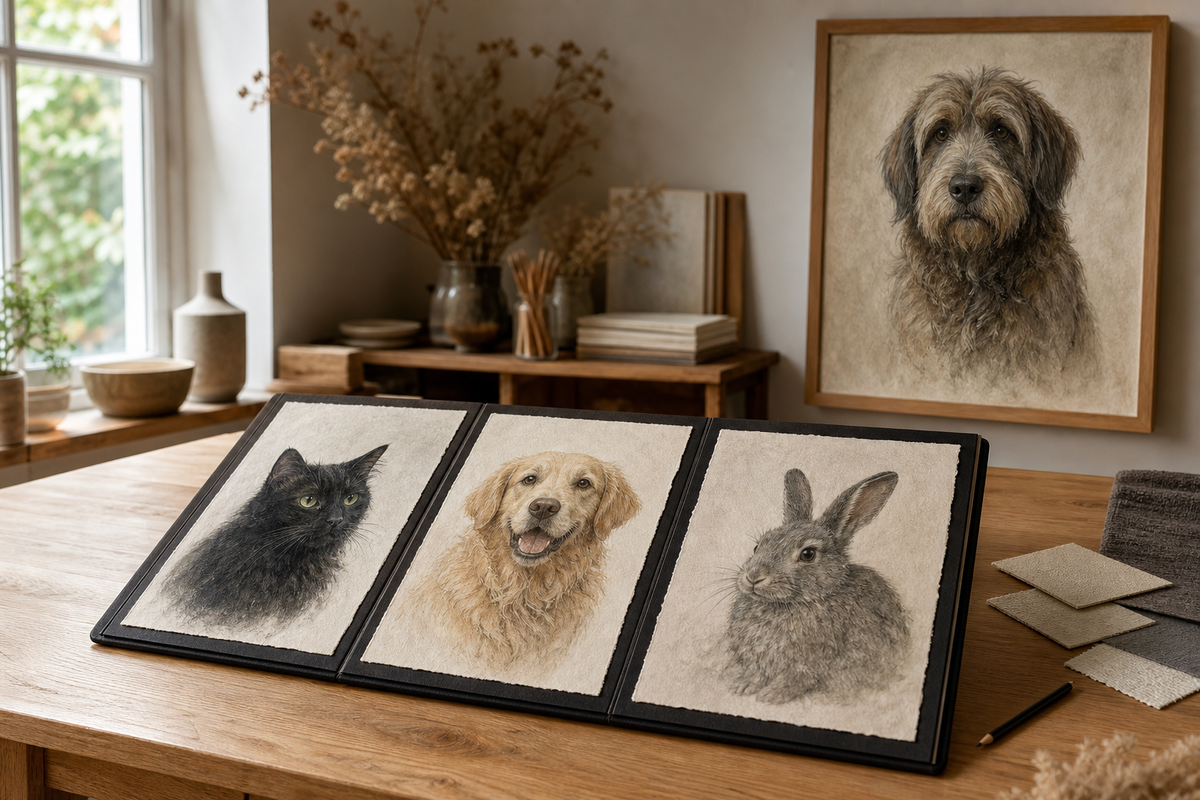
How to choose a pet portrait artist becomes easier when you stop looking for one perfect image in a gallery. Read the portfolio as a record of decisions instead. Can the maker handle a dark coat as well as a pale one? Do three different dogs still look like three individuals? Does the process explain what happens when the supplied photograph is not enough?
A polished homepage may draw you in, but the useful evidence sits in the repeated details: consistent observation, a medium that suits the result you want, and clear limits before money changes hands.
Read one portfolio twice
On the first pass, notice your reaction. Do you like the way the work handles expression, colour and background? Save two or three examples you would be happy to live with. Do not assume an artist will abandon their usual style for a single commission.
On the second pass, look for range without lowering the standard. Compare different breeds, coat textures, face shapes and lighting conditions. A portfolio full of one photogenic subject may be beautiful, but it does not show how the artist deals with short black fur, a flat-faced dog or markings that are easy to simplify.
Consistency does not mean every portrait should look interchangeable. It means the maker's control remains visible while each animal keeps its own shape and expression.
Medium skill matters more than a long style menu
Oil, pencil, digital illustration and needle felting solve different visual problems. A flat drawing can preserve a delicate line; a dimensional fibre piece depends on surface, depth and the way details project from the base. If you are unfamiliar with the latter, the needle-felted portrait introduction explains the medium separately.
Look for several finished examples in the actual medium and format you are considering. One excellent watercolour does not prove the same control in a small sculpture. Equally, a maker who offers only one or two formats may be a better fit than a large menu with little evidence behind each option.
Ask what happens before the final piece
A clear process does not have to be elaborate. You need to know how the maker chooses reference photographs, settles the composition and handles a visible problem before committing to the final work. Ask whether there is a sketch, layout or preview, and at which stage comments are useful.
That timing matters. Moving a head in a simple composition is different from rebuilding finished detail. The existence of a preview is not a promise of unlimited changes, so read the stated boundary rather than filling in the gaps yourself. When a proof eventually arrives, use the separate portrait preview guide for a measured review.

A useful reply is specific, not instant
Send one short enquiry that contains a real constraint. You might say that the lead photograph has the right expression but hides one ear, while another image shows the marking clearly. A useful reply identifies which image can lead and what remains uncertain.
Speed is less revealing than substance. “Yes, no problem” may be friendly, but it does not tell you how the conflict will be resolved. A careful answer may ask for another angle, suggest a simpler crop or explain that a hidden feature cannot be reconstructed reliably.
This exchange also shows whether the maker reads your brief. You are not testing charm. You are checking whether both sides can name the same visual problem before work begins.
Separate artist limits from your preferences
Write down three things that matter most to you. Perhaps the crooked ear must stay, the background should remain quiet and the collar should be omitted only if the fur beneath it is visible elsewhere. Then compare that list with the maker's stated limits.
Some limits are part of the style: simplified backgrounds, head-only compositions or a fixed level of detail. Others belong to the working arrangement, such as the number of pets, reference requirements or the point after which changes are no longer practical. A mismatch is not evidence of a bad artist. It is evidence that this commission needs a different fit.
If a requested detail is not shown in any photograph, treat it as unknown. Confidence cannot turn a hidden marking into evidence.
Price only makes sense with scope
Put the two written quotes beside each other and compare what each includes.
| Ask about | What to compare |
|---|---|
| Medium and output | The medium and whether you receive a digital file, a physical piece or both. |
| Size and display | The finished dimensions and whether a frame or base is included. |
| Subjects and background | The number of pets and the background covered by the quote. |
| Approval and revisions | Whether there is a sketch or preview, when comments are accepted and which changes are included. |
| Delivery and charges | The delivery method, any shipping or taxes shown, and whether a date means dispatch or arrival. |
The pet portrait cost guide compares WYjade's listed formats and prices.
Check that both quotes cover the same job. A lower figure for a digital file and a higher one for a physical, framed piece describe different outputs. Do not use editorial photographs to infer materials, size or included services. Read the current listing and written quote.
Read the terms before ordering
A pet portrait can mark a birthday, a loss or an ordinary part of family life. That emotional weight makes plain terms more important, not less. Before ordering, check the current statements on payment, cancellation, revisions, delivery estimates, damaged parcels and what happens if the available photographs are unsuitable.
For a dated gift, ask whether the date is a dispatch estimate or an arrival commitment, and consider whether the recipient should help choose the image. Keep the reply with the order details. If a point is absent or ambiguous, ask before purchase rather than relying on a social post or an old review.
Use one small test question
A good final question is concrete enough to produce an informative answer: “Which of these two photographs would you use for the eyes, and what would the other one be useful for?” It reveals how the maker assigns evidence without demanding free design work.
Before deciding, make sure you like the portfolio, understand the medium and accept the stated process and limits. For WYjade, check the live felt pet portrait collection for current formats, specifications, availability and terms. The ordering guide explains how to prepare your photographs and order details.
Choose a maker whose work you like and whose explanation of the photographs, process and limits you understand.