August 17, 2026
How to Review a Custom Needle Felted Pet Portrait Preview
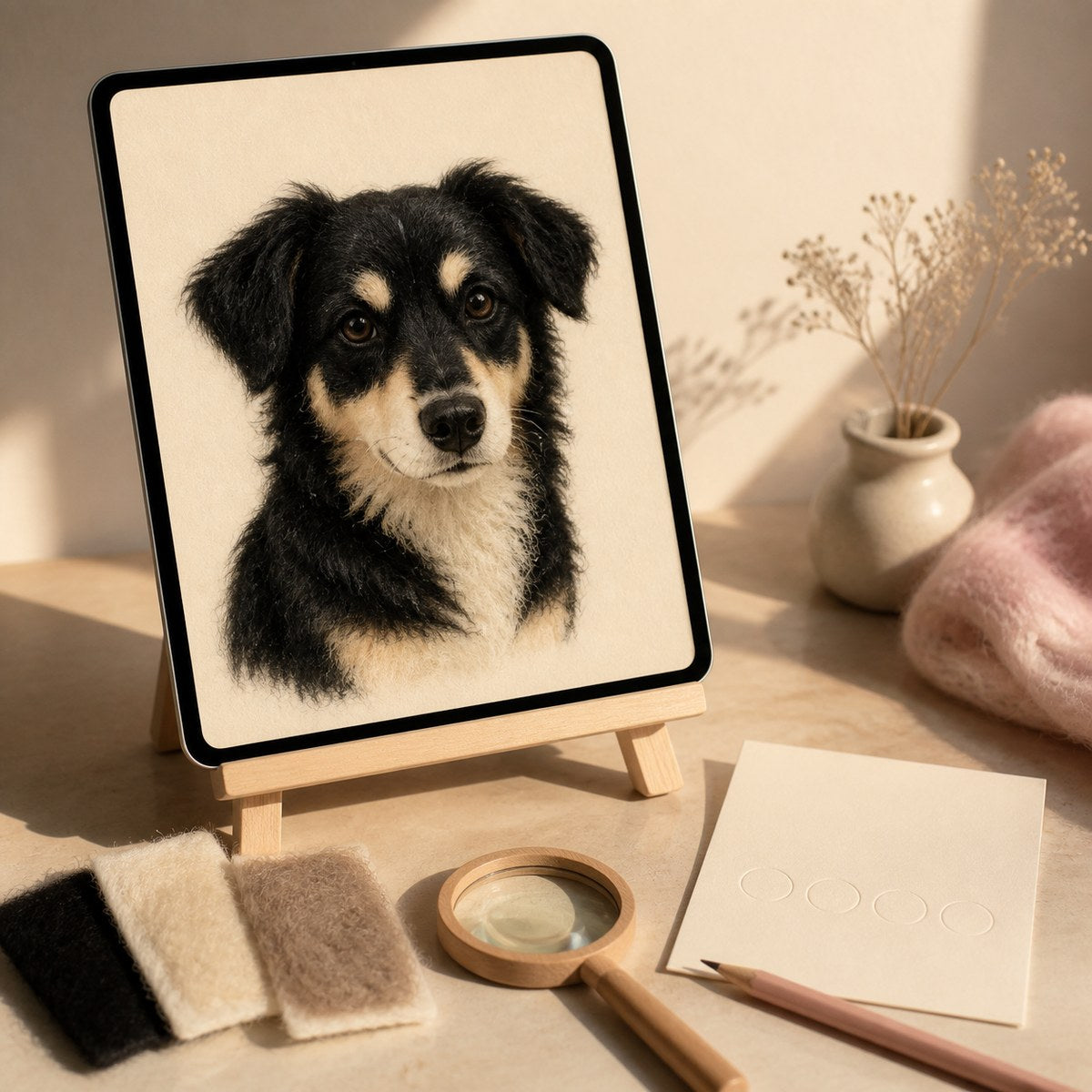
Start with the whole custom pet portrait preview before zooming in. For example, a white blaze may be neatly made but still sit on the wrong side of the nose. Check the overall likeness first, then the spacing and proportions of the features, and finally the markings that make the pet recognisable.
The six size pages in WYjade's custom felt pet portrait collection describe a review before production. They do not currently specify a finished-preview stage or included revision count, and ordering is paused. If your written order includes a finished preview, use the checks below within those agreed terms.
Re-read the agreed scope first
Before judging the preview, return to what was actually agreed: the portrait format, the pet, the face or body view, the pose where relevant, and any detail that was explicitly prioritised. This prevents two different questions from becoming mixed together:
- Does the finished piece reflect the agreed brief?
- Would I now prefer a different concept?
The first may reveal a useful correction. The second is a new creative direction and may fall outside an included revision. If an idea was not in the confirmed scope, ask whether it is possible rather than treating it as an error.
Start at normal viewing size
Look at the whole preview for several seconds before zooming in. Ask a simple question: if the pet’s name were hidden, would the shape and expression feel familiar?
This first impression matters because likeness is relational. An eye can look beautifully made on its own while sitting too close to the other eye. A patch can use the right colour but begin in the wrong place. A pair of ears can contain excellent detail while giving the head an unfamiliar outline.
Write down the first one or two things that guide recognition. Do not send feedback yet. The next checks help determine whether that first reaction comes from a specific, actionable difference or simply from seeing a loved animal translated into a different medium.
Check the silhouette and proportions
Silhouette is often the strongest likeness cue. For a head-focused portrait, compare:
- the overall width and length of the face;
- the height, spacing and angle of the ears;
- the fullness of the cheeks;
- the length and width of the muzzle;
- the transition from forehead to nose;
- the position of the chin beneath the mouth.
For a full-body sculpture, add the length of the body, depth of the chest, leg proportions, tail carriage and the balance of the chosen pose. Review large relationships before tiny surface details. Correcting a minor spot will not solve a head that feels too round or a sitting posture that feels too upright.
Check the face as a set of relationships
Next, look at the eyes, nose, mouth and ears together. You are not measuring mathematical symmetry. You are checking whether their placement produces the familiar expression.
Useful questions include:
- Are the eyes spaced and angled in the way you recognise?
- Does one eye naturally sit a little higher or appear more open?
- Is the nose proportionate to the muzzle?
- Do the ear angles support an alert, relaxed or quizzical expression?
- Is a characteristic head tilt present only if it belonged to the agreed pose?
Avoid requesting “bigger eyes” merely because a phone screen is small. First decide whether the issue is true scale, spacing, angle or contrast. Naming the relationship gives the maker a clearer problem to assess.
Confirm the identity anchors
Now inspect the two or three features that make the pet unmistakably themselves. Typical identity anchors include an off-centre blaze, a broken tabby line, a pale chin, one darker ear, an uneven sock, a patch beside one eye or a distinctive tail tip.
Check four properties: location, shape, direction and relative size. “The white patch is present” is not enough if it rises on the wrong side of the nose. Equally, a handmade piece does not need to recreate every hair to preserve a marking accurately.
For cats with complex coats, use the separate cat coat-marking guide. For preparation before a commission begins, use the reference photo guide; this article is about reviewing the completed preview, not choosing photographs.
Allow for wool and screen variation
A needle felted portrait is a tactile object, while the preview is a photograph displayed on a screen. Wool fibres create texture, small shadows and gentle transitions that do not behave like pixels or paint. The preview angle, lighting and your device can also change apparent colour and depth.
That does not mean colour concerns should be ignored. It means they should be described carefully. Instead of “the brown is wrong”, explain the comparison: “the forehead reads warmer and more orange than the cooler brown agreed for the face”. If the preview does not show a critical area clearly enough to assess, ask what can be confirmed before using any agreed revision round. Do not assume that an unseen angle is either correct or incorrect.
Separate an actionable mismatch from handmade character
| Observation | Best response |
|---|---|
| A defining patch is on the opposite side | Describe the location and refer to the agreed detail |
| The head outline feels wider than the familiar shape | Compare width with muzzle or ear spacing |
| Individual fibres do not match the photograph hair by hair | Accept the natural interpretation of the medium |
| Screen colour looks different but lighting is unclear | Ask a focused question before requesting a change |
| You now want a different pose or added accessory | Ask whether this is new scope, not a correction |
Use any agreed revision round for a specific difference in the agreed likeness or design, such as a marking on the wrong side or an unfamiliar head shape.
Write one clear, prioritised revision message
If a revision is needed, consolidate your feedback rather than sending a stream of separate reactions. A useful message has four parts:
- Confirm the parts that already feel right.
- Name the most important mismatch first.
- Describe its exact location and the desired relationship.
- Separate definite requests from questions about the preview.
For example:
The ear angle and narrow muzzle feel right. My main request is the white blaze: please make it narrower above the left eye and let it widen towards the nose, as agreed. The dark patch under the chin may be the preview shadow; could you confirm that before changing it?
This is more useful than “It does not look like her” because it protects what is already successful and identifies one precise change. Keep the message proportionate to the revision scope you agreed. If several points matter, rank them rather than presenting all of them as equally urgent.
Use a final approval checklist
Before approving, confirm that:
- the overall silhouette feels familiar;
- face and body proportions reflect the agreed view or pose;
- the leading expression is recognisable;
- the most important markings are on the correct side and in the correct place;
- eye, nose and coat colours are reasonable within preview-lighting limits;
- the agreed format and included elements are present;
- any uncertainty has been asked as a question rather than silently assumed.
Once you approve, rely on the current written order and dispatch terms for what happens next. If you are still at the ordering stage, read how to order a custom needle felted pet portrait before choosing a piece.
Frequently asked questions
Should a felt portrait look exactly like one photograph?
No. It is a handmade interpretation in wool. Judge whether the proportions, expression and defining markings preserve the pet’s identity rather than expecting a mechanical copy.
What counts as a revision?
The current product page and written order terms decide that. Do not assume that a different pose, new accessory or changed concept is included simply because a revision round is listed.
What if I cannot explain why the likeness feels wrong?
Return to silhouette first, then compare ear set, eye spacing, muzzle shape and the two strongest markings. Describe the first relationship that differs instead of sending only a general reaction.
Can I trust colour on the preview photograph?
Use it as a review aid, but remember that lighting and screens affect colour. Describe a specific relative difference and ask for clarification when the preview conditions make it uncertain.