August 21, 2026
What Is a Needle Felted Pet Portrait? A Buyer’s Guide
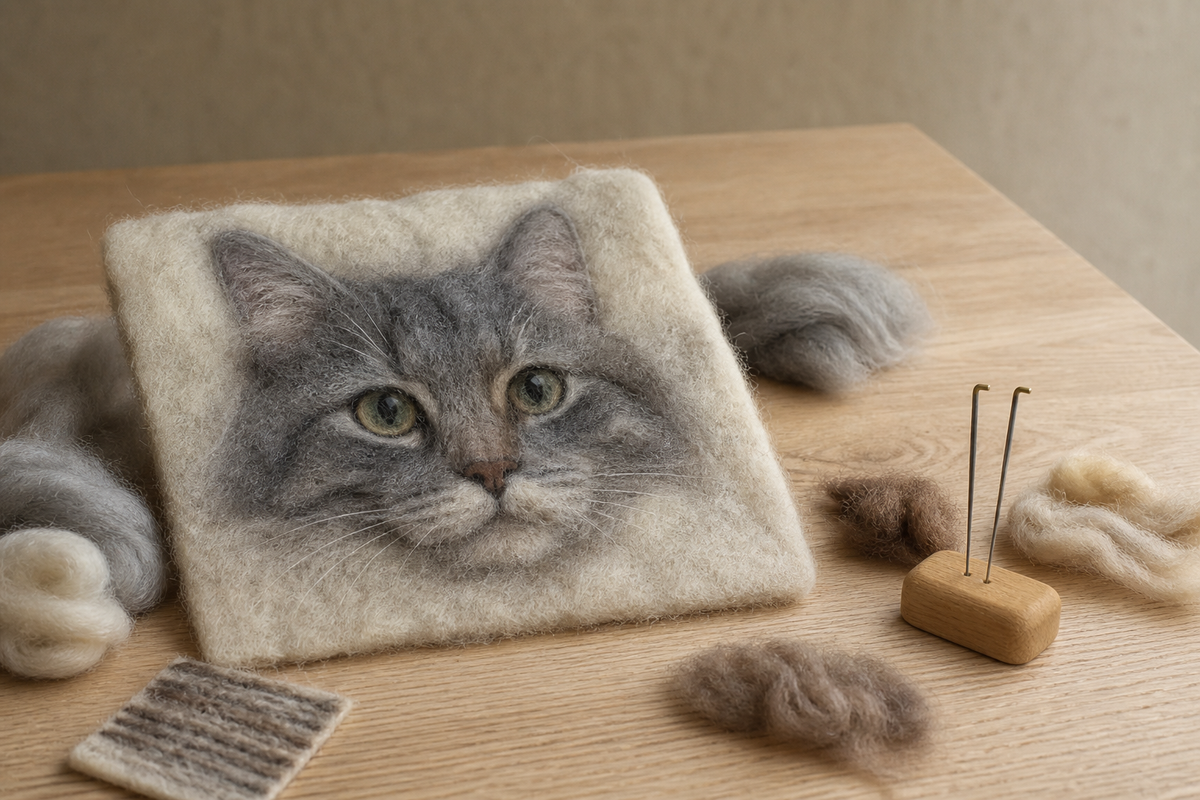
What is a needle felted pet portrait? It is a picture or small sculpture of a particular animal made by shaping fibres with specialised felting needles. Instead of applying colour to paper or printing a photograph, the maker builds form, colour and surface texture with fibre.
The phrase sounds precise, yet it covers several kinds of object. Some portraits are almost flat; others project from a backing or stand on their own. That distinction matters before you compare photographs, dimensions or prices. A front-facing product image can hide most of the depth, so look for a side view too.

Start with the verb: felting
Needle felting uses specialised needles to entangle and compact fibres. The Smithsonian’s National Museum of African American History and Culture describes the technique as using special needles to fuse wool fibres. The Textile Museum of Canada teaches the same medium as a way to shape and attach wool into small sculptural forms.
Repeated needling makes a loose bundle denser and more stable. More fibres can be added for colour, markings and surface detail. The same basic action can produce a flat patch of felt, a raised muzzle on a framed piece or a complete small figure. A felt portrait is therefore built in fibre, not simply printed on fuzzy fabric.
“Portrait” describes the subject, not one standard shape
A portrait represents an individual pet rather than a generic breed. The reference set might show eye colour, ear position, a blaze down the face or an uneven pair of socks. The maker interprets those clues in fibre. The word portrait is not a promise of a mechanical copy.
The finished object may fall into one of three broad families:
- Flat or low-relief work
- Fibres sit on a backing much like a textile picture, with little projection from the surface.
- Dimensional relief
- The face, muzzle, paws or coat rise from a backing or frame, while the work remains a display piece.
- Freestanding sculpture
- The whole animal is interpreted as a small three-dimensional figure, so posture and body markings matter as well as the face.
These labels are useful, but sellers may use them differently. Check photographs from the side as well as the front, and read the listed dimensions. WYjade’s 2D versus 3D pet portrait guide compares these physical formats in more detail.
Follow one marking from photograph to fibre
Imagine a grey cat with a narrow cream line beside the nose. One photograph may show the line clearly but make the eyes look too dark. Another may catch the eye colour accurately while hiding part of the muzzle. A portrait maker needs to know which image leads for expression, which one leads for colour and which detail must not disappear.
In fibre, that cream line is not selected with a paint tool. It has to be placed, shaped and blended into the surrounding grey. A long-haired edge may need a looser surface than a short-haired cheek. Small asymmetries often do more work than a general breed description because they identify this animal rather than any grey cat.
This is why several clear photographs are usually more informative than one polished image. They answer different questions. WYjade’s reference-photo guide covers angles, light and markings; the present article does not replace that preparation step.
Handmade does not mean unspecified
Hand-shaped work will have small variations. That is different from leaving the buyer in the dark. Before ordering, find out what the listing actually says about size, format, display method, reference photographs and the preview process.
Ask when a construction detail matters to you. “Needle felted” describes how fibres are worked; it does not identify every fibre, backing, frame, internal support, adhesive or decorative component. Those details can differ between makers and formats. Do not assume that every piece is all wool, or that every freestanding figure is built in the same way. If the listing is silent, treat the material or construction as unknown rather than filling the gap yourself.
The same caution applies to likeness. A handmade portrait can use photographs to interpret recognisable features, but it should not be sold as an exact clone. Look for a process that lets you state priorities and review the finished work at the stage described by the seller.
What the term does not tell you
The name alone will not tell you the finished size, the amount of relief, whether the portrait includes the whole body, how it should be displayed or how long it takes to make. Nor does it confirm that an old, blurred photograph contains enough information. Cleaning advice also depends on the particular object.
Those gaps are normal product questions, not reasons to guess. Compare the current listing with the images you can supply. If you are still choosing between a frame, charm and full figure, use WYjade’s custom felt portrait format guide. For handling after it arrives, read the separate needle felted pet portrait care guide and keep any maker-specific instructions.
Read the object before you read the sales words
Look at the portrait from more than one angle. Is it a fibre picture, a raised face inside a frame or a complete figure? Can you see the sort of detail that matters for your pet? Does the seller explain which photographs are needed and what handmade variation means in practice? Clear answers make it much easier to compare unlike objects without pretending that one label makes them equivalent.
Once those questions are answered, the phrase becomes straightforward. A needle felted pet portrait is an individual animal interpreted in shaped fibre. The useful buying decision comes next: choosing the physical format and reference set that can carry the features you want to remember.
WYjade’s live felt pet portrait collection shows the currently available formats. Read each product page before ordering, because availability, specifications and process details can change.