August 13, 2026
Cat Coat Markings in Needle Felted Portraits
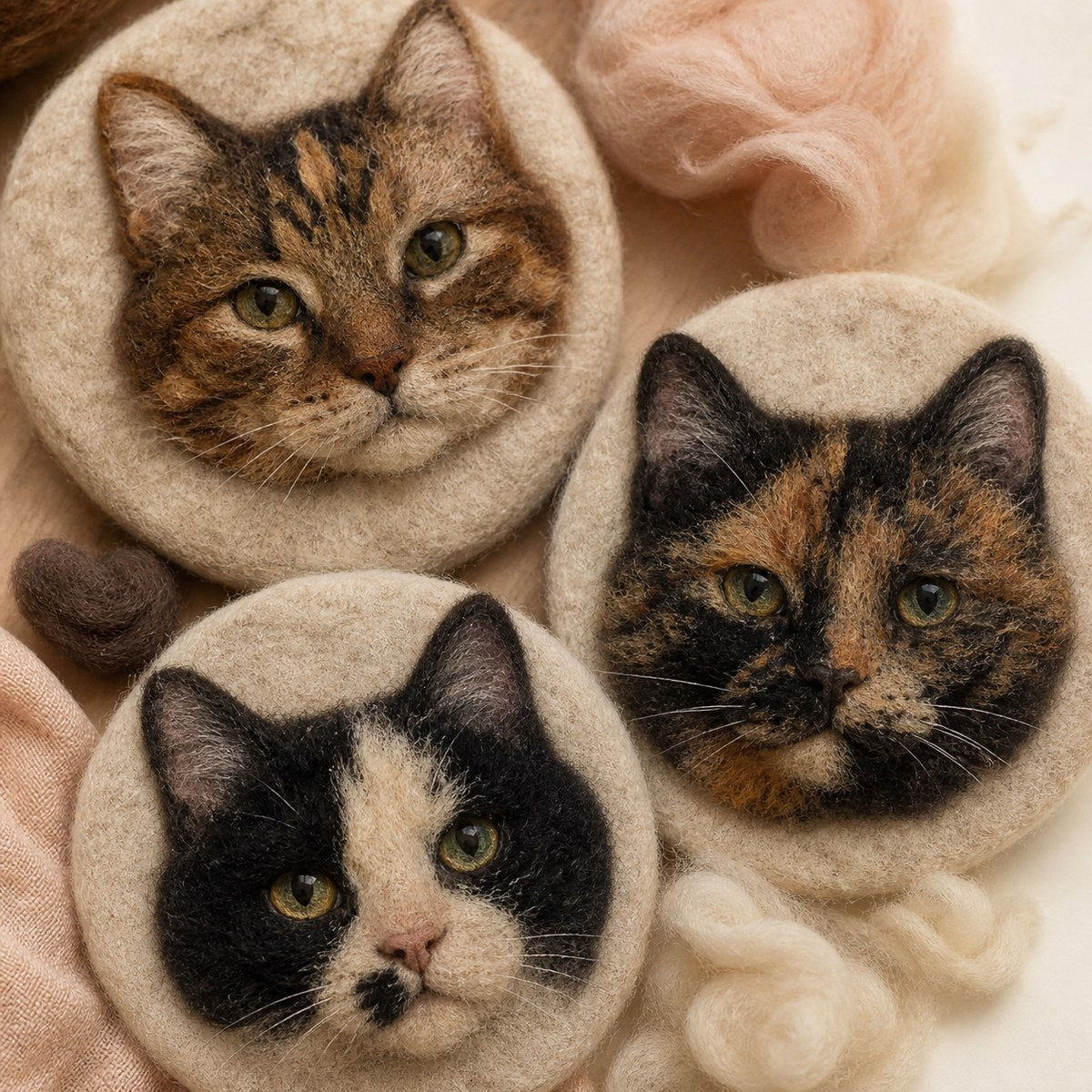
A needle felted cat portrait can preserve a cat's likeness without reproducing every hair. Compare the width of the face, the set of the ears, the spacing of the eyes, the shape of the muzzle and the markings that make this cat recognisable.
That distinction matters when you commission a portrait in wool. A photograph records thousands of details at once; felt interprets them through shape, colour and fibre texture. The most convincing result gives the right details the right priority.
Begin with the individual cat, not a breed stereotype
A breed name can provide context, but it is not a complete portrait brief. Two cats of the same breed can have different face proportions, eye shapes, ear positions and expressions.
Start by describing the cat in plain, observable terms. Is the face broad or narrow? Are the ears tall, rounded, widely set or slightly uneven? Does the muzzle project, or does it sit close to the face? Is the familiar expression alert, solemn, curious or gently unimpressed?
Then identify two or three features that somebody who knows the cat would notice immediately. These might be a cream blaze beside the nose, a dark lower lip, one white whisker pad, a nick in an ear or a forehead stripe that bends off-centre. Those identity anchors usually matter more than a generic label such as “grey cat”.
Treat the coat as a map
Coat colour is not simply a list of wool shades. Markings have location, direction, scale and boundaries. A useful mental model is a map with landmarks.
For a face-focused portrait, the key landmarks often sit around the eyes, forehead, nose, cheeks, chin and ear edges. A full-body sculpture adds the chest, back, legs, paws and tail. The question is not only “Which colours appear?” but also “Where does each colour begin, how far does it travel, and what shape does its edge make?”
This helps avoid a generic version of the same coat type. “White triangle rises between the eyes and leans left” communicates more identity than “black-and-white cat”.
| What to mark | What the note should explain |
|---|---|
| Edge of a white blaze | Where the white begins, how high it rises and which way it leans. Name left or right from the cat's perspective. |
| Break in a forehead stripe | Circle the break and compare its position with the eyes and ears. |
| A pale patch beside one eye | Mark its boundary and relative size. Identify the photograph that shows its colour most accurately. |
What matters for common cat coat patterns
Tabby cats: preserve the rhythm, not every stripe
The Cat Fanciers’ Association describes four principal tabby patterns: mackerel, classic, spotted and ticked. It also identifies recurring landmarks such as the forehead “M”, eye lines, cheek markings, leg bars and tail rings. These terms are useful because “tabby” is a pattern, not a breed.
In a felt cat portrait, the most recognisable tabby information is usually the larger pattern structure. Notice the angle of the forehead lines, the contrast around the eyes, the direction of the cheek stripes and any strong break in the pattern around the nose or chin. On a full-body piece, the spine line, side swirls or spots and tail rings can carry the same role.
In a small portrait, prioritise the dominant lines in the correct places and the contrast between ground colour and darker markings rather than counting every stripe.
Tortoiseshell and calico cats: find the landmark patches
Tortoiseshell coats are mottled rather than regularly striped. Calico cats have white as well as larger areas of darker and red-toned colour. In either case, random-looking colour is not truly random to the person who lives with the cat.
Look for landmark patches: a split-colour face, a flame above one eye, a pale chin, one dark cheek or a coloured ear against a lighter side of the face. Preserve those first. Smaller flecks can then support the overall mottled effect without competing with the cat’s most familiar pattern.
The boundary matters as much as the palette. A sharp division down the nose feels different from softly intermingled colour, and wool retains natural fibre variation rather than behaving like a print.
Black-and-white or “tuxedo” cats: study the edge of the white
“Tuxedo” is a familiar everyday description, while formal coat terminology places black-and-white cats within bi-colour patterns. For likeness, the important information is often the white boundary: whether it covers the chin, rises between the eyes, wraps around the nose or stops unevenly across the chest.
Small asymmetries are particularly powerful here. One white toe, a dark spot on the muzzle or an off-centre bib may be more personal than the broad black-and-white division. In a framed face portrait, prioritise the facial boundary. In a full figure, carry the same map through the chest, paws and tail.
Solid and very dark cats: shape carries the likeness
A black, blue-grey, cream or white cat can appear visually simple until you look at the structure. With fewer high-contrast patches, the outline of the cheeks, ear angle, eye spacing, nose shape and muzzle become more important.
“Solid” should not mean flat. Gentle shifts in tone can help separate the forehead from the cheeks or the muzzle from the neck, while the outer silhouette keeps the cat recognisable at a glance. The aim is not to invent highlights that are not present, but to avoid losing the face inside one undifferentiated block of colour.
If the eyes or muzzle disappear in the reference, the black cat photography guide shows how light direction and background affect visible detail.
Pointed cats: keep the balance between mask and body
Pointed patterns concentrate deeper colour around areas such as the face, ears, feet and tail. For a face portrait, the shape and softness of the mask may carry much of the identity. For a full-body sculpture, the relationship between the darker points and the lighter body is equally important.
The mask's width, symmetry and connection to the ears can vary, as can the contrast between points and body. Individual proportions still come before the category label.
Coat length changes the silhouette
Long hair does more than add texture. It can widen the cheeks, soften the jaw, create ear furnishings and change the apparent size of the chest or tail. Short hair reveals more of the underlying head and body shape. Curled or plush coats create another rhythm entirely.
For that reason, a wool portrait should not treat texture as decoration placed on top of a finished face. The direction and volume of the coat contribute to the outline. A long-haired cat with a narrow skull may still appear broad because of the ruff; a short-haired cat may be recognised by a clean cheek line and prominent ears.
Decide which details must lead
Before commissioning, write a one-sentence identity brief. Keep it concrete and ranked. For example:
Keep the narrow face and tall left ear first; the broken forehead stripe and small cream patch under the right eye are the two essential markings.
This is not a replacement for the maker’s required photographs. It is a way to explain what the photographs mean to you. Avoid a long list in which every whisker has equal importance. If everything is labelled essential, the true identity anchors disappear.
You can use WYjade’s separate reference photo guide for image preparation and the ordering guide for the commission sequence.
Choose a cat-focused keepsake
The Small Cat, Medium Cat and Large Cat pages each list Framed Needle Felt and Full-Body Needle Felt. A framed portrait concentrates attention on the face; a full-body figure also needs references for the chest, paws and tail. Compare the written dimensions in the custom felt pet portraits collection. Ordering is currently paused.
Handmade wool has its own texture and variation. Judge the finished portrait by the cat’s proportions, expression and defining markings rather than by individual hairs.
Frequently asked questions
Do I need to know my cat’s official coat colour?
No. Accurate everyday observations are more useful than an uncertain formal label. Describe the visible colours, pattern boundaries and features that matter to you.
Can a solid black cat make a distinctive felt portrait?
Yes. A dark coat shifts attention towards silhouette, ear set, eye spacing, muzzle shape and subtle tonal changes. Those structural details can be highly individual.
Does every tabby stripe need to be copied?
No handmade portrait can or should function as a pixel-for-pixel transfer. Prioritise the major facial lines and distinctive pattern breaks that make the cat recognisable.
What if my cat’s markings are asymmetrical?
Keep the asymmetry. An uneven blaze, one pale paw or a patch beside only one eye can be a stronger identity cue than perfect balance.