August 30, 2026
What to Write in a Pet Sympathy Card: Use One Real Memory
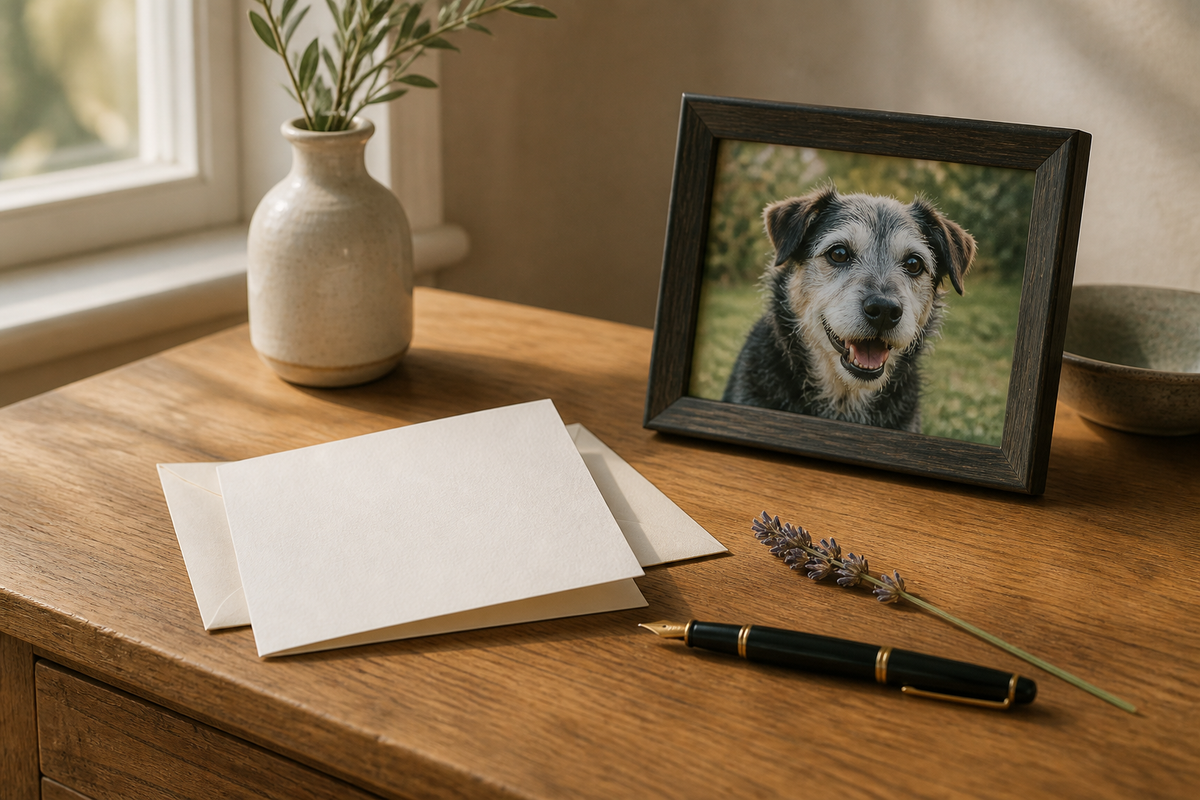
If you are deciding what to write in a pet sympathy card, begin with the pet's name, acknowledge the loss and add one true memory if you have one. A short note can be enough.
Adapt these examples to your relationship. Use the pet's name only if you know it and can check the spelling; include a memory only if it is yours.
Let the relationship set the length
A close friend may welcome a full paragraph and a familiar memory. A colleague or neighbour may prefer two quiet sentences.
For a colleague
I was very sorry to hear about Luna. I know how much she was part of your life. Please do not feel you need to reply.
For a friend whose pet you knew
I am so sorry about Luna. I will always remember how she inspected every visitor's bag before saying hello. I am thinking of you.
Change the name and wording until the message sounds like you. Replace the memory with something you genuinely remember, or leave it out if you did not know the pet.
Begin with the name you both knew
Write the pet's name if you know it and can check the spelling. "I was so sorry to hear about Pip" recognises an individual life. "Sorry about your dog" may sound distant when you have met Pip many times.
If you never knew the name, do not guess or quietly substitute a generic endearment. A simple line such as "I was sorry to hear that your cat died" is kinder than a false intimacy. The RSPCA's pet bereavement guidance recommends acknowledging the loss and using the pet's name. It also advises listening, asking gentle questions and respecting a request for space.
Choose one memory that belongs in your handwriting
The most personal part of the card is often small. You may remember the dog waiting at the same gate, the cat occupying the warm laundry, or the rabbit rearranging a blanket before settling. Pick one detail you genuinely saw. It does not need to summarise the animal's whole life.
If you did not know the pet, write about something you observed in the person instead: "You always spoke about Mabel with such affection" or "It was clear how much care went into her life with you." Keep the claim within what you actually know.

Say sorry without trying to repair the grief
Plain sympathy is enough. "I am so sorry" does not need a lesson about time, fate or looking on the bright side. A card cannot make the death reasonable, and the recipient does not need to perform reassurance for you.
Avoid "it was only a pet", "at least they lived a long life" and suggestions about getting another animal. Those lines reduce a particular relationship to a category or timetable. Blue Cross guidance on supporting someone after pet loss advises against suggesting a replacement pet and notes that people grieve in different ways and for different lengths of time.
Be cautious with "I know how you feel" as well. Even if you have lost a pet, the two relationships are not identical. You can share your own experience later if they invite it. The card should keep its attention on them.
Make help specific, then leave room to decline
"Let me know if you need anything" is generous, but it asks a grieving person to design the help. When your relationship allows it, offer one manageable action: bringing dinner on a named evening, handling a routine errand, or sitting with them for a while. Keep the choice with them.
A card can say, "I can leave dinner at your door on Thursday if that would help. No need to answer today." Do not promise open-ended availability you cannot give. If the person wants space, accept that without reading it as rejection.
Handle a group card without flattening the pet into a label
A group card from a workplace, club or family does not need one oversized message speaking for everyone. Let one person write a plain shared acknowledgement, then leave room for individual names. People who knew the pet can add a short memory. People who did not can simply sign with sympathy.
Check that the group wording does not exaggerate the relationship. "We know how much Jasper meant to you" can be true even when most signers never met him. "We all loved Jasper" should be reserved for a group that genuinely did. Do not use the card to ask for details about the death or to announce a collection for a gift before the recipient knows about it.
Write honestly if the news reached you late
A delayed card can still acknowledge the loss. Do not backdate your feelings or make the recipient comfort you for missing the news. "I only just heard about Nori, and I am so sorry" is complete. Add a memory if you have one, then continue with the same restrained support you would have offered earlier.
Avoid guessing how the person feels now. Grief does not follow your calendar, and a later note does not need to reopen or close anything on their behalf.
Use faith language only when it belongs to the recipient
Some people find comfort in heaven, prayer or the Rainbow Bridge. Others do not. Do not introduce a belief because it is printed inside the card or common in pet memorial language. Use it only when you know the recipient uses it themselves.
Neutral wording can still be warm. Mention the pet's character, the care they received, a shared memory or the place they held in everyday life. You do not need to describe where the pet is now.
Keep a memorial gift separate from the sentence
A card may accompany flowers, a donation in memory of the pet, a photograph or a portrait. The object should not turn the note into a sales pitch or require an emotional reaction. If you are unsure whether a physical keepsake is welcome, send the card first or ask someone close to the recipient.
The guide to pet memorial portrait ideas covers private, literal and symbolic remembrance. If a commissioned portrait is already wanted, use the separate guides to choosing a pet portrait artist and preparing useful reference photographs. Current WYjade formats must come from the live felt pet portrait collection. A card does not need to mention the gift's price, making time or specifications.
Read the note once for accidental pressure
Check the pet's name and pronouns. Remove advice about how long grief should last, any suggestion that the person should feel grateful, and questions that demand a quick reply. If the card contains more about your discomfort than their loss, shorten it.
Then stop editing. A natural ending such as "Thinking of you", "With sympathy" or "I am here when you want company" is enough. Sign your own name. Keep the pet's name and any shared memory in your own words.