August 26, 2026
Pet Portrait Background Ideas: Choose the Job First
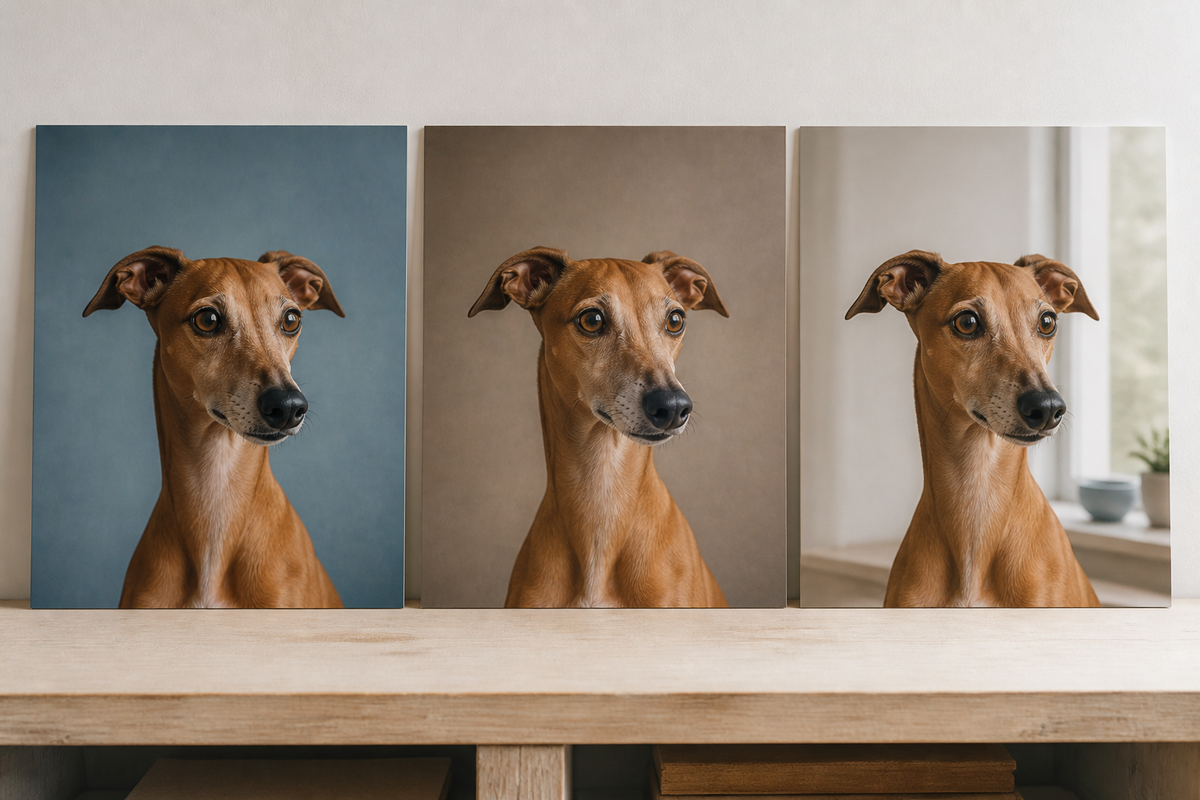
Pet portrait background ideas are easier to compare once you decide what the space behind the animal is meant to do. It can clear the stage for a face, suggest a mood or preserve one recognisable place. Asking it to do all three usually leaves the portrait crowded.
Start with the pet and the crop, then work outwards. A background should support the expression and outline that you care about. It does not need to rescue a weak reference photograph or reproduce every object that happened to be in the room.
Give the background one job
Write a short answer to this question: when you first look at the portrait, should you notice the face, the atmosphere or the place? That answer narrows the useful options.
| Background job | What it needs | Common risk |
|---|---|---|
| Keep attention on the pet | A plain field or restrained texture | Too little separation from the coat |
| Set a mood | Soft shifts in value, colour or light | A dramatic effect that competes with the eyes |
| Keep a place | One or two features that make it recognisable | Turning the pet into a small figure inside a busy room |
None of these jobs is more serious or more personal than the others. A plain ground can hold a strong memory. A specific place can be useful without becoming a detailed landscape.
Plain does not have to mean empty
A single colour, a soft gradient or a lightly mottled surface can give the face room. This direction suits a close crop, a patterned coat or a portrait intended for a visually busy wall.
Judge it beside the actual animal rather than choosing a fashionable shade in isolation. A black coat may contain warm brown or cool grey reflections. White fur may carry cream, blue or violet shadows. The background only works if ears, whiskers, muzzle and outer edges remain readable.
Use the reference-photo guide to check focus, light and useful angles. Once you have chosen a reliable image for the face and coat colour, decide on the background.
An atmospheric background keeps the setting unresolved
Atmosphere sits between a solid colour and a recognisable scene. It might use a warm haze, a cooler edge or broad tonal shifts without naming a particular room or landscape. This can add depth while leaving the pet as the only precise subject.
Ask to compare the calmest version with the most dramatic one. The quieter option often makes small features easier to see. A dark-on-dark portrait can still work, but it needs controlled separation around selected edges rather than a hard outline around the whole animal.

A meaningful place needs evidence
A window ledge, green chair or garden gate can belong in the portrait when it is part of how you remember the pet. Start with the feature that makes the place identifiable. The rest can soften or disappear.
Do not ask a maker to reconstruct a room from memory if its shape matters. Supply a separate photograph of the setting and say which detail carries the recognition. If the location belongs to a memorial brief, the pet memorial portrait guide keeps that emotional decision separate from the visual mechanics here.
Visible evidence also sets a limit. A photograph of one corner does not prove what was behind the camera. A simplified suggestion is more honest than confident invented architecture.
Crop decides how much story will fit
A head-and-shoulders crop leaves little space for furniture, horizon lines or a path. Trying to force a full room behind it can make the animal feel pasted in front of a miniature set. A wider or full-body composition gives the setting more work, including a believable surface beneath paws.
For more than one animal, background and scale have to be solved together. Use the multi-pet portrait guide for relative size, eye lines and the group shape before choosing scenery.
Check where the crop cuts ears, chest, tail and paws. The background cannot repair an awkward boundary. It can only make that boundary less or more obvious.
Remove detail in the order it distracts
Look at the proposed setting with the pet hidden. Which object takes attention first? High-contrast window frames, sharp leaves, patterned upholstery and bright highlights can pull the eye away even when they are meaningful.
Reduce the least important item before changing the whole idea. A chair can become one block of colour. A garden can keep its path and lose individual flowers. A room can retain the window light without preserving every frame and cable.
This is not a request for blur everywhere. Keep the feature that explains the place. Simplify the parts that merely document it.
Test the background where the portrait will live
Screen colour is a poor substitute for the room. Daylight, warm bulbs and nearby wall paint can change how muted green, blue or taupe feels. Place two or three plain colour samples against the intended wall and look at them in daytime and evening light.
Also notice the frame and neighbouring pictures. If the wall already has strong patterns or several small artworks, a quieter background may give the pet more space. On an empty wall, an atmospheric field may carry more weight without becoming noisy.
Current formats and physical options must come from the live felt pet portrait collection. An editorial image cannot prove available sizes, materials, backgrounds or customisation.
Write a brief that leaves room for judgement
A useful background brief can fit in four lines:
- the job: face, atmosphere or place;
- one reference trusted for the pet;
- one background detail that must remain;
- one thing that can be removed or simplified.
Add the intended room only when it affects colour or scale. Avoid giving ten equal instructions. If every object is labelled essential, the maker has no reliable way to establish visual priority.
When a layout or proof is available, review the subject first and the background second. The portrait preview guide gives that detailed sequence. For this decision, ask one final question: if the background became slightly quieter, would the pet be easier to recognise? The answer usually reveals whether the setting is doing its job.